If you just moved to the Netherlands or planning to move or tired of your current dutch broadband plans provider then it’s time to look for the best Dutch broadband plans provider. In Holland, high-speed internet connections are in high demand. According to Akamai’s quarterly State of the Internet report, the Dutch internet ranks in the top six countries in the world in terms of speed. The average internet speed is 15.6 Mbps.
Below you can compare different plans from different companies as per your need.
While there are numerous choices, think about your requirements before signing a contract.
Cheap & best Holiday deals allow travellers to get the most out of their next vacation. You’ll have a lot more money to spend on having fun travelling and visiting while you’re away if you save money on the accommodation and flights. Saving money on travel and lodging for your next vacation means you may spend it on fine dining, water activities, and family days at theme parks, among other things.
How Can you save money in Netherlands? Paying taxes can sometimes be a bit heavy on your pockets and when tax season arrives its bit of headache also. All you need to do is to be informed about Tax Deductions!!
What are Tax Deduction expenses?
Tax Deductions expenses are job-related expenses on which you can claim tax relief.
If you’re self-employed or have to fill in a self-assessment tax return, or are claiming for relief then you must use your self-assessment to claim tax relief on expenses.
Type of Medical Expenses in the Netherlands
Medical expenses can blow any budget but when your deductible medical expenses exceed the threshold of your adjusted gross income, you can claim the amount over that threshold as an itemized deduction. Interestingly, these expenses can include the premiums you pay for your health insurance after using tax money.
If you are self-employed, you might be able to deduct all of your health insurance premium costs as an “over the head deduction” that can reduce your adjusted gross income. Over the head deductions can be taken without requiring you to itemize your deductions. This way you can save a lot on your taxes.
Type of Child Care Expenses in the Netherlands
The cost of having a child care provider to watch your children might be Tax Deductions. If you are working partners, you need help to look after your child then these expenses can be deduced from your taxes. To claim child care expenses, you’ll need supporting documentation, whether the provider is an individual or an organization, including the child care provider’s:
Name
Tax identification number
Address of the location where the childcare was provided
In some states, you’ll also need to report the child care provider’s telephone number
Your child care expense is not technically a Tax Deductions. It’s covered under the Child and Dependent Care Tax Credit, which might be even better.
Child care Expenses
Type of Job hunting costs in the Netherlands
Job hunting can be stressful enough, let alone having to handle all of the expenses that go along with it. Luckily, job search deductions can help you out. The major aspect you need to focus on is that your job search must be within your field. For example, you wouldn’t be eligible if you went from a job in the marketing field to education. Below is a list of eligible expenses that can be deducted.
• Resume preparation – Make sure you keep all the receipts for hiring someone to professionally rewrite your resume. • Phone calls with potential employers whether you get the job or not. • Gas, mileage and other travel expenses that you accumulated while interviewing. • Moving costs after you’ve finally landed that new job that might have sent you halfway around the country.
Making the decision to start a business can be stressful, and there are several unavoidable costs associated with it. But you can claim for relevant start-up costs up to seven years before the business begins operations. Expenses such as computers and software, professional fees to ensure your company is registered correctly, internet and web domain fees, and even advertising are all Tax Deductions.
In addition, any expenses that are paid for using personal funds can be claimed for when the company or legal entity starts trading, so be sure to keep receipts and maintain accurate records as you’re going through the start-up process.
Gambling losses
Paying taxes on your gambling winnings can be frustrating, especially if the amount you won is less than the amount you lost. You can deduct your gambling losses from your winnings. You will just need to keep a detailed record of all your losses and winnings and make sure that you include your winnings as taxable income. You need to keep record of:
• Date and type of gambling • Business name and address where you were gambling • The people that you were gambling with • The amount you won and lost
Also, you will be needing some documents like W-2G form, 5754 form and receipts from the casino to prove your gambling losses.
Donations in the Netherlands
Donations to a registered charity by a limited company are an allowable expense, and the value of the donations can be deducted from business profits before paying tax, reducing your corporation tax bill. To claim tax relief, you must keep a record of donations showing the date, amount and which charities you’ve donated to.
For donations of land, property or shares, you need to keep legal documents showing the sale or transfer to the charity and any documents from a charity asking you to sell land or shares on its behalf.
Donation in the Netherlands
What are Teaching costs in the Netherlands?
Teachers have to reach into their own pocket every now and then to purchase items needed for the classroom. While it may sometimes seem like nobody appreciates that. It allows qualified K-12 educators to deduct up to $250 for materials. That gets subtracted from your income, so you can take advantage of it even if you don’t itemize.
Accidents, and Damages
There are things that are simply out of our control, like your car breaking down, your roof caving in after a storm, or even you actually breaking a leg. If you don’t have insurance and you have to pay out of pocket for repairs and medical bills, you can include them when you’re filing for taxes as a tax deduction. It’s not all bad luck after all!
Are you Wondering how to post on Instagram from Computer? You may already be able to use a PC or Mac to create, edit, filter, and upload Instagram photos. We’ll demonstrate you how.
Facebook confirmed recently that Instagram will introduce the option to write and publish posts directly from your PC. Instagram users could only upload stories from their phone app until recently.
Being a blogger I can understand the need of flexibility to use Instagram for publishing your stories directly from the desktop. After all no one wants use a platform that limit users from sharing their content.
Instagram Post
How to post on Instagram from desktop?
Maybe you’re one of the fortunate few who already has the function turned on, Instagram will notify you with a pop-up when you log in, according to 9to5Mac. And if you do, here’s how to publish to Instagram from your computer:
In the top right corner, click the Plus button. It’ll show in the middle of the screen, between the messages and the compass icons.
Select photographs or movies from your computer or drag and drop them.
Make changes to your post with filters and edits.
Add a caption and a geotag to the post, as well as tag others in it.
Click the Share button.
On either Android or iPhone, this is how to conceal likes on your Instagram page and how to capture the finest photos available.
Alternatives to Post on Instagram from Computer
You can upload to Instagram from your Desktop or Mac using the methods shown below. We’ll also teach you about using Hootsuite, which operates on both Mac and Windows.
1. Using Hootsuite: Post on Instagram from your computer
2. Using Creator Studio: Instagram Post from Desktop
If you prefer Instagram to other social media platforms and don’t mind not having all of your accounts in one place, Creator Studio might be a fantastic fit for you.
How to use Creator Studio to post to Instagram:
In Creator Studio, make sure you’re connected to Instagram.
Go to the Instagram area of the menu.
Create a new post by clicking Create Post.
Go to Instagram Feed and choose it.
Select the account to which you want to post (if you have more than one Instagram account connected).
Add a caption and a location to your photo (optional).
To upload photographs or videos, click Add Content.
Choose one of the following two options: To add new content, click From File Upload & To post content that you’ve shared on Facebook, click From Facebook Page.
Click Publish
3. Mac Instagram Uploader: How To Post on Instagram from MAC
Log in to your Instagram account using Mac’s default browser, Safari.
Go to the Advanced part of the Preferences menu after clicking on the Preferences menu.
Click the Show Develop Menu in Menu Bar button next to the menu bar.
It will take you to the Develop Menu, in which you must select the User-Agent option.
From here, you can select the Instagram mobile interface you would like to use.
After that, your tab will be updated once more, and you’ll be ready to start uploading photos and videos from your Mac.
4. How to Post on Instagram Using a Scheduler
Alternatively, scheduling Instagram posts is one of the simplest techniques on our list. You can always utilize a scheduler and arrange your stream ahead of time to avoid any mistakes in the future. There are numerous schedulers available to help you with this work.
However, if you want to share your work without receiving push alerts, we recommend selecting one with an auto-publish function. Later provides one such Instagram Scheduler.
The first step is to upload all of your photos and video files to Later’s Media repository.
You can use different labels to organize your material and make it easier to discover later.
The next step is to create a weekly or monthly content calendar.
Open the calendar, then go to the week tab and double-click on the time window that you want to use.
Drag and drop your stuff from the library onto the calendar.
You can easily arrange your Instagram feed ahead of time now that you’ve scheduled your posts for higher engagement.
If you have a business account, you may use the auto publish option to have your content automatically uploaded from a PC or Mac machine.
You will be required to pay income tax in the Netherlands if you live in the country or get income from it. In the Netherlands, you pay taxes on your earnings, financial interests in a company, and savings and investments. Income tax is collected by the Tax and Customs Administration. It spends tax dollars on roads, benefits, and the judiciary.
The Beginning of the Taxes in The Netherlands
The connection of people with taxes in the Netherlands is centuries old. People have been paying taxes for centuries. In the 18th century, the Dutch government was assured of income by taking tax on necessary goods like firewood, soap, salt, grain, meat, wine, coal and wool. Back then, people used to pay the same amount of taxes, regardless of their income.
Then, in 1806, Alexander Gogel, Minister of Finance, introduced a system of general taxes and in1914 income tax (inkomstenbelasting) was introduced. The purpose of this tax is to tax people according to their income. The more money you make, the more tax you have to pay.
Before starting the tax paying process, you must have knowledge about a few tax forms and their use according to your personal situation.
This is for those who have lived in the Netherlands only for a part of the year; example, people who have immigrated to or emigrated from the Netherlands the year before.
This is for those who don’t live in the Netherlands at the moment, but earn Dutch income (non-resident taxpayers).
W-form
This form is for the self-employed professionals.
F-form
This form is for relatives of a deceased person.
The whole tax system is defined in terms of Boxes in Netherlands. The income is differentiated in terms of boxes and taxes are paid according to the levels set for each income box.
Box 1 Income
Box 1 comprises the income from:
Income from your business.
Income from profits, employment, and homeownership
Income as a freelancer, artist, childminder or professional athlete.
Income from pension and benefits.
Gratuities such as tips.
Foreign income
Tax Rates: In 2021, earnings up to €68,507 are taxed at 37.1%, while earnings over the limit are taxed at 49.5%. All workers have a general tax credit of €2,837.
Exemption: In some cases, the income can go tax-free under certain strict rules. Which are:
specific medical expenses
alimony and other maintenance obligations
study expenses
temporary stay at home for the severely disabled
deductible costs of homeownership
Box 2 Income
Box 2 income includes:
Regular benefits such as dividends.
Capital gains, such as gains on shares.
Taxes: Box 2 covers income from a substantial interest or holding (at least 5%) in a limited company such as a BV. In 2021, income in Box 2 is taxed at 26,90%. In 2020, this was 26,25%, and in 2018 and 2019 income in Box 2 was taxed at 25%.
Box 3 Income
Box 3 covers income from assets such as savings and investments. The value of your assets, minus debts, is calculated once annually, on January 1, to determine your net capital value. Everyone is entitled to an amount of tax-free capital (heffingsvrij vermogen).
Taxes: The tax-free capital limit has risen significantly to €50,000 in 2021, from €30,846 in 2021. If you are married, you and your partner are entitled to a collective tax-free capital of €100,000. Whatever amount that remains after the subtraction of the €50,000 allowance is taxed at a rate of 31%
Exemption:
The property you live in (if you own it).
Moveable property such as furniture, art or a car (unless they are an investment).
Certain kinds of insurance.
Investments in forests, nature or certain green, social, ethical, cultural or startup projects.
Important!!! The 30% ruling
The 30% ruling is a tax incentive for foreign employees who bring specific skills to the Netherlands. The benefit is calculated based on their gross annual salary. From this total amount, 30% of the amount is free from income tax. Furthermore, except for pension premiums, all other bonuses, holiday allowance, other benefits fall under the 30% ruling.
If you an expat you are subject to pay taxes in the Netherlands to the Belastingdienst. The term income tax, familiar among most of the working folks, refers to a type of tax that governments impose on income generated by businesses and individuals within their jurisdiction.
Taxes in The Netherlands
Say, if you are making money in America you have to pay taxes to the American Government and same as that if you are working in Netherlands you have to pay taxes to the Government of Netherlands.
But why we have to pay the government our hard-earned money? Being a responsible citizen of any nation its our duty to pay income tax since these taxes are used by the government for carrying out various welfare and development schemes. If you are a newbie in the field of taxes, this article will do wonders for you.
The Dutch Tax and Customs Administration (Belastingdienst)
Belastingdienst is responsible for collecting taxes and social security contributions in the Netherlands. In the Netherlands, the fiscal year runs from 1 January to 31 December. The time frame for submitting income tax returns is from 1 March until 30 April. Better get it done 2-3 days before the deadline.
If you have been employed in the Netherlands, payroll tax is withheld from your salary each month. If your salary is €100,000, then the income tax due on your salary is €42,000 and the payroll tax on salary will be €42,000 leaving a balance = €0. You must keep in mind, if you received income which hasn’t been taxed, you are legally obliged to request a form and at least file a tax return.
There are three different types of taxable income which is classified in boxes and each has its own tax rates. To calculate your taxable income, you need to aggregate your income in the three boxes, which are, income from work and homeownership, financial interests in a company, savings and investments.
You must be wondering on what types of incomes you have to pay taxes. You have to pay taxes on salary and tips, business profits, benefit, pension, annuities, and maintenance payments and income earned as a self-employed, freelancer, artist, or professional athlete.
Tax Return
How to File your Income tax return in Netherlands
You can file your taxes online via the Belastingdienst website. However, this program is only available in Dutch and you will first need to apply for a DigiD. The Belastingdienst focuses on digital communication. Activate your online account at MijnOverheid.nl in order to access your messages. To use this service, you must first have a DigiD.
If you are an expat, you can take help from a tax accountant or adviser who specialise in expat and international tax issues. Please keep in mind that if you do not already have a DigiD account, it can take a few weeks to arrange this. So, you cannot leave it to last minute. If you arrived in or left the Netherlands in the course of the year, filing a tax return may be particularly advantageous.
After submitting a tax return, you will receive a preliminary assessment from the tax authorities. It takes between 6 to 12 weeks after the return has been submitted. In the case of an M form, it can take up to 24 weeks before the assessment is made.
The preliminary assessment is simply an estimation. Once tax authorities have checked the return, you will receive a final assessment along with payment or refund details and you are good to go!!!
Apart from its stunning landscape, its canals, its culture and its relaxed atmosphere, the Netherlands is a perennial favourite of all when it comes to health care benefits given by the government.
The Dutch healthcare system is ranked the second-best in Europe (behind Switzerland) according to the Euro Health Consumer Index. So, this country takes health care of all seriously.
How does the system work?
The Dutch health insurance system is a combination of private health plans with social conditions built on the principles of solidarity, efficiency and value for the patient. Healthcare in the Netherlands is funded through taxation: mandatory health insurance fees and taxation of income. Some points to pay attention to:
If you are from EU: You are obliged to obtain a health insurance in The Netherlands when You have a (part-time) job and/or pay income tax in The Netherlands or you are 30 years or older and your stay in The Netherlands is not temporary.
If you are not from EU: Expats from outside the EU/EEA eligible for a Dutch health insurance if you have a permanent Dutch residence permit. Within 4 months of receiving your residence permit, you must get your basic health insurance.
Dutch Healthcare
What happens if I don’t get Dutch Health Insurance?
If you do not sign up for basic Dutch health insurance within four months and the government discovers you are uninsured, you will receive a letter from the CAK requesting that you do so within three months.
If you do not obtain health insurance within that time frame, the CAK will levy a fine (426,24 euros in 2021).
If you still haven’t done anything after six months, you’ll be fined again for the same amount.
If you haven’t gotten health insurance within nine months of receiving the first letter, the CAK will sign you up with an insurer on your behalf and collect the monthly premium from your pay.
If you’re unsure if you really need health insurance in the Netherlands, then can approach the Sociale Verzekeringsbank to see if your circumstances need it.
If you fall ill and do not have (Dutch or international) health insurance that covers treatment in the Netherlands, you will be responsible for all medical expenses.
How to choose a Dutch Health insurance provider
To choose a provider, all you can do is compare the benefits provided by one with the other. When comparing providers, ask the following questions:
How much is the premium?
How does the policy work?
What is the excess?
Can you take out supplementary insurance for any care or treatment that’s not included in the standard package?
Steps to enroll for health insurance
For getting covered under health insurance, one needs to follow the below steps:
You have to register with your local municipal body and receive an identification number known as BSN (Burgerservicenumber).
You have to purchase medical insurance from a private insurer.
You have to register yourself with primary health provider.
What gets covered under basic health insurance?
Dutch insurance companies are obliged by law to offer you the basic package. They cannot deny coverage because of gender or nationality. As set by the government, the basic health insurance costs around 100 euros per month and covers things such as:
Appointments with your doctor and doctor prescriptions.
Stays at the hospital, surgery and emergency treatment
Ambulance services and patient transport
Medicine and Blood tests
Dental care for children under 18 years
Limited dental care for adults over 18, restricted to dental surgery, dental x-rays
Mental health care
Appointments with medical specialists such as dermatologists, allergists or internal specialists
Pregnancy, birth care, midwifery services and Maternity care
Handicapped care
Nursing on location
Some therapeutic services such as speech therapy, occupational therapy and diet advice
Physiotherapy for chronic disorders, covered from the 21st treatment onwards.
No One plans of getting ill, but for unavoidable circumstances one must always be ready to tackle those circumstances and getting insured can be fruitful in those cases.
To get tips about finance management and save money, visit Finance management by 50-30-20 rule.health insurance Netherlands expat health insurance
Digitization has brought a revolutionary change in the way people access information and in providing this easily accessible information, mobile phones are playing a major role.
An increase in mobile usage has upped the game for businesses globally. There are 6.3 billion smartphone users globally, and 88% of mobile time is spent on applications and why not!! Mobile apps have become an essential tool for companies and brands.
More than 50% of a website/product’s audience comes from mobile phones and tablets. With the risen use of mobiles there comes user expectations and delivering the best experience across platforms is quite a challenge.
When a user makes the switch between desktop or mobile version, he/she expects to make the transition seamlessly and you also must have gone through this scenario. Talking about PWAs, let’s find out what are PWAs?
What is PWA and what makes Progressive Web Apps unique?
Progressive Web Applications (PWAs) proposed by Google’s Senior Software Engineer, Alex Russell in 2015, is the perfect confluence of websites and mobile apps that allows websites to look, feel, and behave like apps.
Combine the features of Native mobile apps with the amazing capabilities of web and you get a progressive web application. It is different and better than Native apps in many ways. as stated below.
Progressive Web Apps (PWA) vs Native Apps)
Top 5 Reasons how PWAs will impact business in 2021
Fast connections
Today, consumers have options. There are plenty of places to browse news, buy clothes, and watch videos. If your website isn’t fast enough (literally), people will take their attention somewhere else.
For instance, if your website takes anywhere from three to 12 seconds to fully load, those delays can cause 53 percent of users to leave your website. Once you switch to a PWA, browsing sessions increase by 43 percent.
SEO capabilities
Aside from the fact that speed affects your page rankings, PWAs are also SEO-friendly. Because they live on the web, their content is visible to search engines. This can boost your ability to generate traffic and leads.
Native apps are limited to the SEO constraints of app stores. Typically, only the app profile page is listed in Google search results. With a PWA, you have the same unlimited flexibility as a website to create custom user experiences and optimized resourceful content that will rank on Google and showcase your app’s features and benefits.
Offline User Access
PWAs can be operated when the device is offline. While a website requires an internet connection, the built-in service workers cache the most important features and data of the web app automatically.
Once cached, users can access most of the features without an internet connection. If a user attempts to open a page that has not been cached, the web app can show a custom offline page. What else a user wants, you are having all the data offline, that’s great!!
No Manual Installation or Updates
Unlike a native app, users don’t need to visit the app store to download and install the app before it can be used. When you install from app store, first you have to install the app, you have to login, then give permissions, update the app regularly and what not.
But if you using a PWA all this comes at one click, i.e., you just have to click “Add to home screen” and it’s done. One more benefit of using PWAs is they take less than 1 MB of your mobile phone’s battery and if something is taking this less battery then why spend memory on larger apps.
In-Budget
The cost of development and maintenance of a PWA is significantly less than a native app. Because of the different requirements for Android and iOS, you’ll need to develop and maintain two versions of a native app. With a PWA, a single development caters to all operating systems and devices, thus providing your business greater benefits.
Keeping above factors in mind, we can say that PWAs are the future of business.
Apart from the best sceneries, famous wooden clogs, windmills, tulips gardens and mesmerizing travel destinations, this small and amazing country in Europe offers us all the reasons to come and study here. Netherlands is known for its best education around the world.
There can’t be any doubt in this point, since around 90,000 international students study in the Netherlands and the number is exponentially increasing. Ever wondered what could be the reason behind the craze for Netherlands among students? Let’s find why.
Prestigious Universities and Quality of Education
Education system of Netherlands is one of the oldest and most reputable higher education systems in the world. Large number of universities in the Netherlands with best courses places it top in the global rankings. The Netherlands ranks 7th among the world’s top 10 countries for higher education and also scores 3rd globally for teaching quality.
What makes the Education system of Netherlands among the best in world is the unique teaching method which includes teamwork, seminars, workshops and practical experiences. Teachers [refer to teach in small groups of 15 students to deliver better education. Great efforts by teachers, Hats off!! Who would not want to study in Netherlands.
Better scholarship programmes to support your education
The availability of scholarship support offered both through the Dutch government and higher education institutions adds to the reasons why the Netherlands is one of the top choices for international scholars. The government here is so welcoming to international folks and that’s the reason that one in every 10 university students is an international student. Scholarship opportunities include the following:
After graduating from universities in the Netherlands, most students have one major goal in mind and that’s finding a job. It’s important to think about your employment opportunities after you complete your studies, especially if you are studying and living abroad.
Students who study in the Netherlands tend to want to stay forever so, after graduating, they set out to get a job and stay there for a long time. With one of Europe’s most competitive economies, getting a job after studying in the Netherlands is not only possible, it’s highly likely! And why not it is 4th in world for career goals. According to the 2014 Global Connectedness Index, it is the world’s most internationally connected country (economically and geographically) and this makes it home to great opportunities. Connections matter!!
No Language Barriers
When it comes to education, or anyways, there are no languages barriers here. Approximately 95% of locals speak English making it comfortable for international students for survive, despite being a non-anglophone country. Netherlands is known for the education it provides in English.
Along with that you get to learn other languages like Dutch, French and German. The education system of Netherlands offers over 2,100 international study programs, taught entirely in English which covers masters, bachelor’s & Ph.D. Programs of different fields. It is the First country in Europe and worldwide in the English proficiency index. Also, it’s always valuable to take an introductory Dutch language course to pick up the basics, and many universities in the Netherlands offer Dutch languages courses for internationals to ease their stay.
Graduation Ceremony Netherlands
Multicultural Environment
Only degrees and knowledge won’t make you the smartest person in the room. Experiences matter. People around you matter. Diversity matters. Students learn so much from cultures and Netherlands is the best place for all those experiences.
International students from all over the world come to study in the Netherlands. International students from a total of 157 different countries, mostly from Germany, China, Belgium, Italy and Spain move to Netherlands every year to pursuing education and why not, the people here are welcoming and always happy to help.
Most Dutch universities have International student associations, which help students throughout their studies. The people here move on in their lives with a “live and let live” attitude and that’s what students want.
According to the most recent statistics, only 4% of site visitors actually make a purchase. Occasionally, they aren’t ready to buy when they initially appear at your store, and other times, they may become distracted before completing a purchase.
As a result, marketers are faced with a critical challenge: What is the best way to get them to return to you? How can you get the 96 percent of people who didn’t buy anything from the website to come back? Retargeting is a smart strategy to remind shoppers of their original interest and entice them to complete their purchase is a smart strategy. Let us see how.
What is Retargeting?
Retargeting is a cookie-based method that employs basic Javascript code to discreetly ‘follow’ your audience around the Internet.
After visitors leave your website without purchasing, retargeting ads remind them of your products and services. It allows you to retarget visitors who have visited specific pages and show them relevant visual or text ads when they visit other websites. With the help of Google AdWords, Facebook retargeting, LinkedIn Ads and other retargeting advertising networks, retargeting campaigns can be run. Successful marketers employ retargeting to stay in touch with their customers and improve revenue.
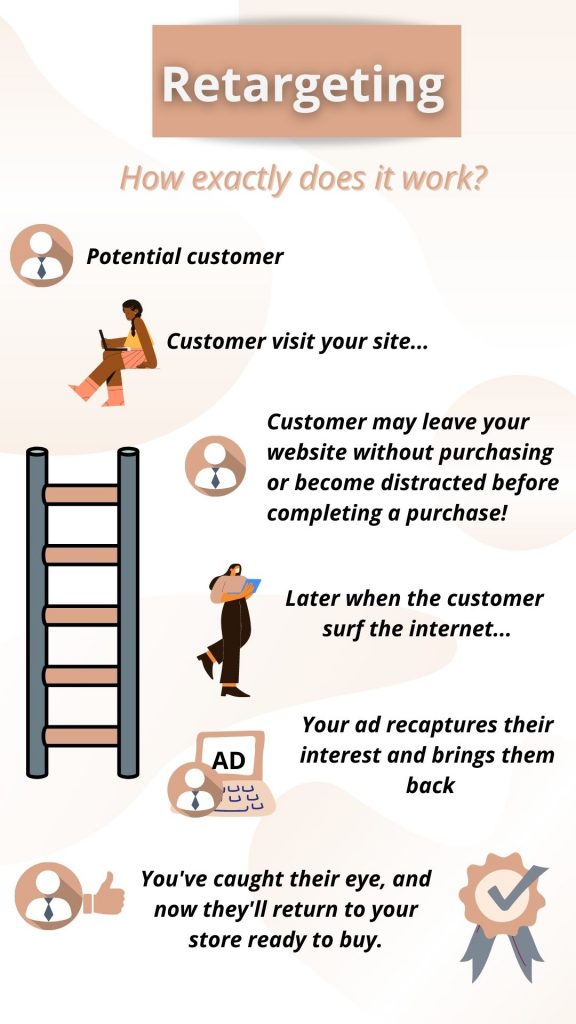
How exactly does Retargeting works?
you install a tiny, inconspicuous script on your website (this Javascript code is sometimes referred to as a pixel). Because the code is hidden and doesn’t influence your site’s performance, it won’t be noticed by visitors. An anonymous browser cookie is dropped every time a new visitor arrives at your site.
After you set up retargeting, if someone who has previously visited your site returns to the web, the cookie that you have placed will ensure to remind your brand intriguing by ad for a product they viewed plus other related products and that no one else will see them.
It’s as easy as clicking a few buttons; using this tool, you may regain lost sales in the background while you focus on other vital aspects of your business!